


The Center for Black Educator Development (CBED) will host the 2025 Black Men in Education Convening (#BMEC2025) in Philadelphia, November 20–22, bringing together educators, advocates, and thought leaders from across the country. The three-day gathering comes at a critical time, as school systems nationwide continue to face teacher shortages.
The Black Wall Street Times spoke with Chief Program Manager for CBED Dr. Orpheus Williams about what attendees can expect this year.
“It started in one room with under 100 folks, and grew exponentially over the next couple of years.” Dr. Williams continued, “Now we’re up to 1,400 registered attendees, over 80 breakout sessions, over 100 main stage speakers, ranging from panels to individual keynote speakers this year.”
“One of our fireside chats on Saturday will be a conversation between the rapper and activist Wallo, sports writer and reporter, Bomani Jones, Lupe Fiasco, who’s a rapper, artist, activist and professor, and Etan Thomas, a former NFL player. They’re going to be there in a moderated conversation about what their educational experiences were,” said Dr. Williams.
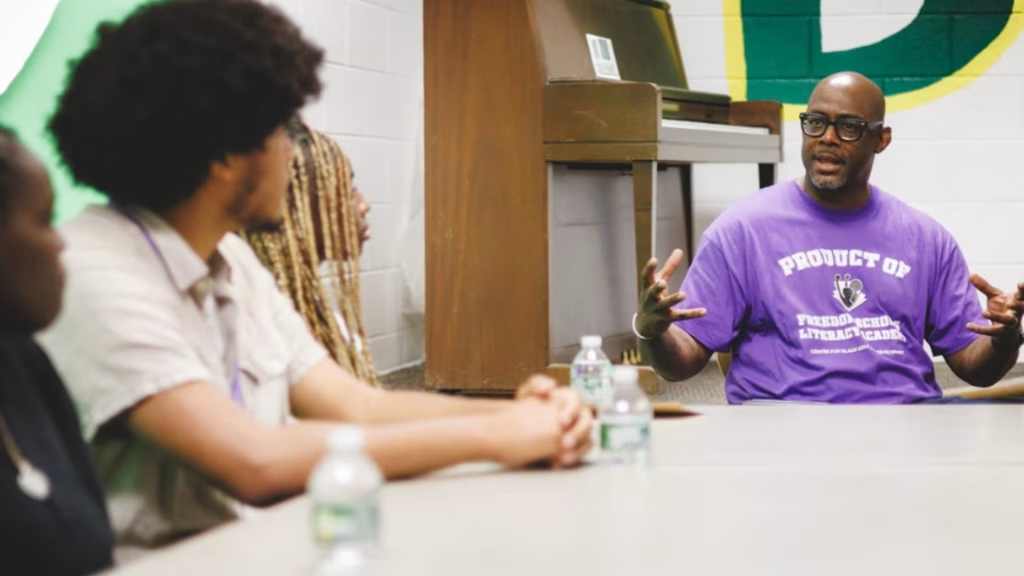
Black men only account for 1.3% of teachers
The need is urgent: Black educators represent only seven percent of U.S. public school teachers, while Black men account for just 1.3%, even though they make up more than six percent of the U.S. population.
“There isn’t a gathering like this under this theme in the US right now. And considering everything that we dealt with, still with the ripple effects coming out of covid, considering the political climate, people are looking for community. Black educators, and particularly Black male educators, are looking for a community to be reinvigorated, re-inspired, but also to remember that they’re not alone.”
With teacher shortages worsening nationwide, #BMEC2025 provides a critical space to equip educators and leaders with the tools to expand pathways to education careers, increase representation, and ensure a more just education system.
“First and foremost, we make up almost 15% of the student population, but overall, it’s about six to seven percent of the teachers are Black. And when you think about male teachers, that numbers drops even more drastically.”
He elaborated, “So the idea of ensuring that our Black students have someone in their world experience that looks like them, that shares some aspect of their cultural, linguistic and historical heritage; if that doesn’t happen, we drastically lower the odds of our students from our communities being able to persist in a K-12 setting, much less being able to get to college and going forward.”
Students rise when education is taught by Black teachers
Dr. Williams continued, “Research also tells us that Black teachers, when they’re in place, the confidence, the feelings of safety and assuredness for all students rise.”
Headlining this year’s convening is Dr. Leslie Fenwick, renowned scholar and author of Jim Crow’s Pink Slip. She will be joined by Dr. Greg Carr, Associate Professor and Chair of Afro-American Studies at Howard University; Dr. Lisa Delpit, MacArthur “Genius” and author of Other People’s Children; Dr. Chris Emdin, scholar and leading voice on culturally responsive pedagogy.
“Part of the other programming that we provide through the Center for CBED is an opportunity called ‘Teaching Academy’, where we’re working with high schools to create a course that they can implement from ninth grade to 12th grade that exposes students, particularly Black and Brown students, to what it means to be a teacher and connected to what it means to be a servant leader.”
#BMEC2025 to address multiple issues in education
Across keynotes, panels, breakout sessions, and performances, #BMEC2025 will tackle pressing issues in education, including systemic inequities, leadership, wellness, student voice, and strengthening the Black teacher pipeline.
“It’s eighth grade and ninth grade, where we see a lot of Black students, particularly Black males, drop out; with our programming, there’s an immediate improvement. There’s also a sense of safety, and the decrease in the number of disciplinary actions that happen against them when they have a Black teacher.”
Dr. Williams continued, “And then there’s the academic outcomes overall, which stem from their engagement. So they stay in school, they feel good and engaged in school. They are empowered by their instructors, and then their outcomes academically, as far as their grades also improve.”
The convening is designed as both a forum for bold ideas and a community space rooted in Black teaching traditions and innovation.
“We’re not going anywhere”
“Unfortunately, a lot of our cousins and sister and brother organizations have had to fold because of the pressures, and we are holding on to a lot of the hope that they’ll be able to resurface. But despite the jeopardy, we fought this fight before, as an organization, we’re not going anywhere, and people can be confident that what we do now, we’re going to continue to persist and find ways to get the message out,” affirmed Dr. Williams.
Asked how people can support CBED, Dr. Williams responded, “I would say, constantly checking in with the decision makers in your local district or town or city about the latest education policies that are going to have an impact on our Black and Brown students, and how can you have a voice in that decision making. If you need help or support in creating arguments or thinking about ways to support current policy or combat changes to things that might have a negative effect, look us up, email us. We have bit of a national perspective on things that are happening in education.”

Really great read — I appreciate how clearly you explained the importance of local online presence for businesses today. It’s a topic many companies overlook, but it truly makes a difference. I recently came across Lokando24.de, a German business directory that helps local companies get found more easily, and your points align perfectly with what they’re building. Thanks for sharing such valuable insights!