


Bad Bunny’s 2026 Super Bowl LX Halftime Show—fondly dubbed the “Bentio Bowl”—was a celebration of culture and unity, delivered amid the intentional hatred and backlash he faced after his performance was announced.
Fresh off an “Album of the Year” win at the 2026 Grammy Awards for his sixth studio album, Debí Tirar Más Fotos, the Bayamón, Puerto Rico native became the first Spanish-language Latino artist to headline the game’s coveted Halftime Show. He did not take that history-making moment lightly.
He opened unapologetically in his native tongue, introducing himself not just as a global superstar, but as Benito Antonio Martínez Ocasio—the former Econo supermarket employee who was bagging groceries just 10 years ago.
“Mi nombre es Benito Antonio Martínez Ocasio, y si hoy estoy aquí en el Super Bowl 60, es porque nunca, nunca dejé de creer en mí. Tú también deberías de creer en ti. Vales más de lo que piensas. Confía en mí.”
(Translation: My name is Benito Antonio Martínez Ocasio, and if I’m here today at Super Bowl 60, it’s because I never, ever stopped believing in myself. You should also believe in yourself. You’re worth more than you think. Trust me.”)
His 13-song set unfolded across stages deeply rooted in the history of Puerto Rico and the broader Caribbean, bridging Latin, African, and Central and South American cultures.
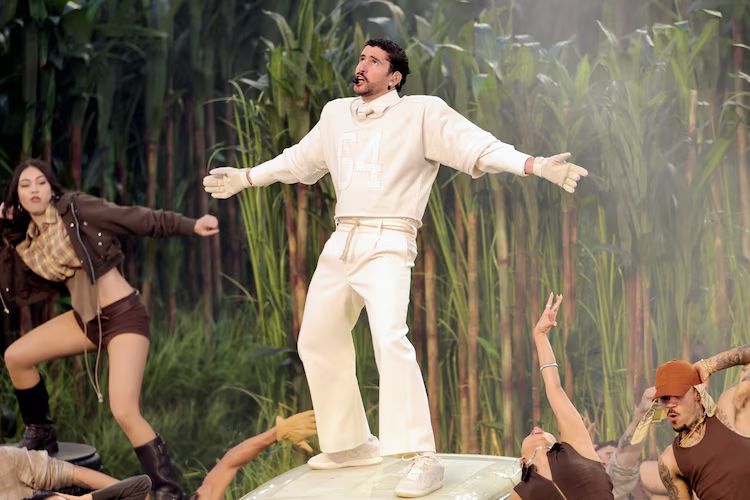
Swaying grass symbolized the sugarcane fields that once confined enslaved Africans brought to the island during the early years of the Transatlantic Slave Trade. The production then shifted to bodega and block party scenes, where Samba and Bomba dancers moved to the rhythms of the güiro and conga drum.
In a surprise moment, a real couple was married amid the swirl of dancers—an intentional nod to the idea that love can live even in chaos.
The “DAKITI” singer’s sentimental moment of handing a Grammy to a young version of himself reinforced a central message of the night— that dreams are not reserved for those who speak a certain dialect.
Bad Bunny also welcomed Lady Gaga for an uptempo version of “Die with a Smile,” su”prised the crowd “ith fellow Puerto Rican icon Ricky Martin, who sang a verse of “Lo Que Le Pasó a Hawa”i,” and returned to his “eggaeton roots with a nod to mentor Daddy Yankee through a high-energy performance of “Gasolina.”
Other notable Latin stars joined him onstage throughout the show, including actor Pedro Pascal, actress Jessica Alba, singer Karol G, and Cardi B, who featured Bad Bunny on her 2018 single “I Like It” alongside J. Balvin.
He closed the performance with a parade of flags and a roll call of countries across the Americas and the Caribbean—including Venezuela, Haiti, and Canada—many of which have been referenced in recent ICE rhetoric and immigration debates under the current administration.
At his pre-show press conference, he addressed the language debate with one pointed line, “English is not my first language. But it’s okay, it’s not America’s first language.”
Just as his speech c”nveyed a sense of duality, the performance included several textual and symbolic moments that underscored unity. Stadium screens flashed the phrase “The only thing more p”werful than hate is love,” a line Bad Bunny has”used before, which read as a clear response to years of polarizing political rhetoric. In the finale, he spiked a football inscribed with “Together, we are America,” signaling his belief that the nation is defined by its many peoples and cultures—not by enforced sameness.
While detractors tuned into alternative programming, including the Turning Point USA Halftime Show headlined by Kid Rock, there was little denying that Bad Bunny’s message of love and collective identity resonated far beyond language barriers.
Drawing more than 135 million viewers—with some estimates as high as 142.3 million—the performance reportedly set a new record for the most-watched halftime show in history.
Before a global audience, Bad Bunny delivered more than entertainment. He offered a celebratory proposal for a different vision of the United States—one where unity is built through shared culture, not demanded through uniformity.
Check out some of our favorite moments from Bad Bunny’s Super Bowl LX Bunny’s Show performance.