


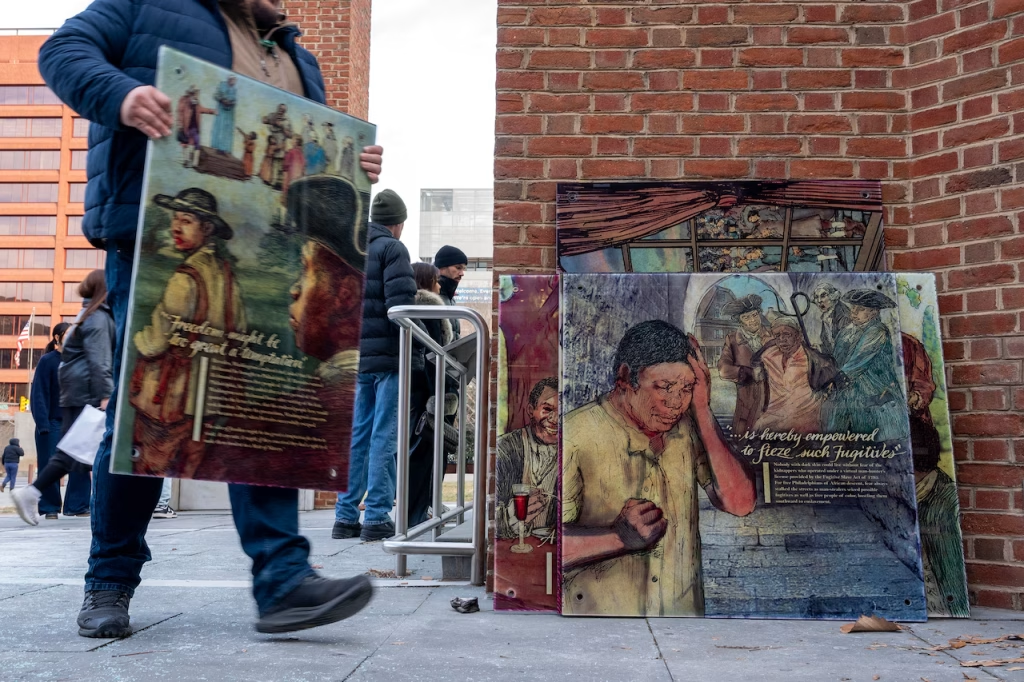
On Thursday, Jan. 22, the National Park Service began removing a memorial honoring the lives of nine people enslaved by President George Washington from a national park in Philadelphia, Pennsylvania.
The “Freedom and Slavery in the Making of a New Nation” exhibit at the President’s House opened in 2010 and was displayed outdoors at Independence National Historical Park, also known as Independence Hall. The park is also home to the Liberty Bell.
City officials and community advocates argue that Thursday’s dismantling is part of a broader effort by the Trump administration to erase and distort the nation’s history.
“Donald Trump will take any opportunity to rewrite and whitewash our history,” Gov. Josh Shapiro, a Democrat, wrote on X. “But he picked the wrong city — and he sure as hell picked the wrong Commonwealth. We learn from our history in Pennsylvania, even when it’s painful.”
Philadelphia City Council President Kenyatta Johnson also criticized the removal, calling it unacceptable.
“Removing the exhibits is an effort to whitewash American history,” he wrote. “History cannot be erased simply because it is uncomfortable. Removing items from the President’s House merely changes the landscape, not the historical record.”
According tothe city of Philadelphia has filed a federal lawsuit seeking to have the exhibit restored.
The outlet reports that the lawsuit references previous issues with the National Park Service, citing its failure to effectively handle disputes or seek approval through “communication, consultation … or other forms of non-binding alternative dispute resolution that are mutually acceptable to the parties.” The complaint names Interior Secretary Doug Burgum, acting National Park Service Director Jessica Bowron, and the National Park Service.
The removal of the monument stems from Trump’s “Restoring Truth and Sanity to American History” executive order issued in March 2025. The order directed federal agencies, including the Interior Department, to ensure monuments and materials under their jurisdiction do not include content that could be deemed to “inappropriately disparage Americans past or living,” promote “ideological indoctrination,” or advance “divisive narratives.”

The order specifically identified monuments in national parks as a priority for “restoration” ahead of the 250th anniversary of the Declaration of Independence.
The U.S. Interior Department provided a statement to ABC News confirming that the dismantling was carried out in compliance with the president’s executive order.
“The Department of the Interior is implementing Secretary’s Order 3431, which carries out President Donald J Trump’s Executive Order on ‘Restoring Truth and Sanity to American History,’ the statement said. “The President has directed federal agencies to review interpretive materials to ensure accuracy, honesty, and alignment with shared national values. Following completion of the required review, the National Park Service is now taking action to remove or revise interpretive materials in accordance with the Order.”
The department also stated that the president’s executive order required agencies to “improve the infrastructure” by July 4, 2026, in preparation for the 250th anniversary of the signing of the Declaration of Independence.
The order went on to directly criticize monuments at Independence Hall.
“At Independence National Historical Park in Philadelphia, Pennsylvania — where our Nation declared that all men are created equal — the prior administration sponsored training by an organization that advocates dismantling ‘Western foundations’ and ‘interrogating institutional racism’ and pressured National Historical Park rangers that their racial identity should dictate how they convey history to visiting Americans because America is purportedly racist,” the executive order said.
Michael Coard, a Philadelphia attorney and founder of the advocacy group Avenging the Ancestors Coalition, led the decades-long fight to establish the memorial. He told ABC News that his group is planning a “powerful action” in response to its removal.
The “Freedom and Slavery in the Making of a New Nation” exhibit consisted of panels and plaques that named and told the stories of Austin, Christopher Sheels, Giles, Hercules, Joe Richardson, Moll, Oney Judge, Paris, and Richmond. The exhibit explored the contradiction between liberty and enslavement in the early republic, describing everyday life under slavery, the transatlantic slave trade, and the economic system that supported and benefited from enslavement. Visitors learned through themed narratives such as “Life Under Slavery” and “The Business of Slavery.”
Leave a comment